How do you feel about Climate Change?
Responding to uncertainty, Building Climate Resilience
The Capital P Lab
Contributing Writer
- #Climate Emotions
- #Mental Health
- #Climate Resilience
- #Budget2026
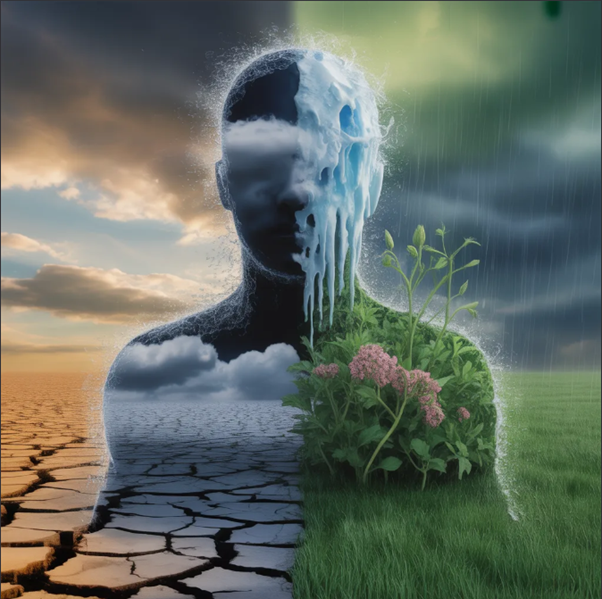
How does Climate Change make you feel?
Living in the haze: The air stirs emotional havoc
For most people in North India, winter now arrives with a familiar rhythm — as the cold settles in and cities move more slowly, news bulletins follow with warnings of rising AQI levels. Smog coupled with stubble burning across agricultural lands in Punjab, Haryana and Uttar Pradesh set off almost apocalyptic scenes of a near orange, hazy atmosphere across the NCR region. A sick smoky acrid taste is left in the mouth when one steps out. The pattern returns every year, with no meaningful respite — only a steady rise in the use of air purifiers across homes and offices.
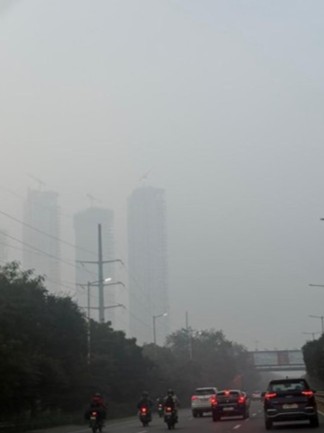
A winter afternoon in the National Capital Region, 2025
Photo Credit: Mehar Singh Chauhan
Loads of discussion but few solution
India’s business houses and government policy circles talk of ESG solutions and yet the fundamental problem remains as it is. We all agree with the thoughts raised by one concerned citizen on a social media post - ‘Clean air isn’t a “nice-to-have”- it’s the baseline for a functioning society’.
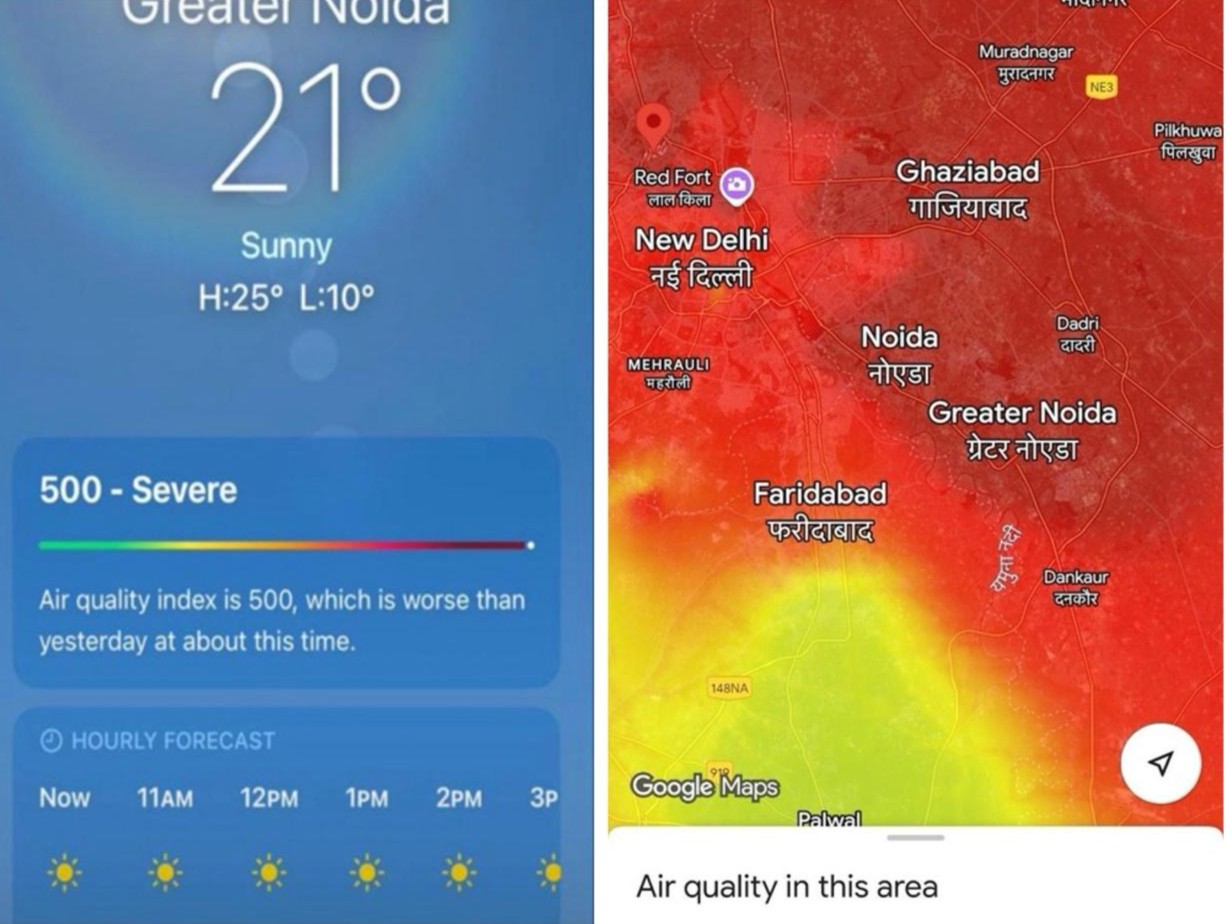
Photo: The new norm? How does it make you feel?
This pattern though is not confined to New Delhi alone, with cities like Mumbai following suit. In 2025, Delhi maintained its position as India's most polluted megacity, with Mumbai frequently ranking among the top 10 globally, often following behind Delhi and other cities in pollution severity. While Mumbai occasionally saw higher daily pollution levels, Delhi continued to record the highest overall annual PM2.5 levels in 2025.
Cities breathe in and out desperation
How do people then respond to this? What is felt every year is anger, frustration, helplessness and a resigned sense of apathy through messages, status updates, posts and comments. A few placards and street protests in severely polluted air on the need for urgent action to tackle polluted air.
To make sense of these citizen responses and channel them to individual, collective and policy changes is an oft sidelined subject. A heightened sense of stress and anxiety of this order around climate issues needs to be quantified and qualified into what is yet a little explored subject – climate emotions!
What are Climate Emotions?
Climate Emotions are valid, intense psychological responses to environmental changes due to climate change.
While climate anxiety is the most commonly addressed aspect across literature and practice, there is in fact a wide spectrum of climate emotions. These range from eco anger to eco frustration, eco-guilt, eco-grief, eco-powerlessness, eco-responsibility, eco-hope and even eco-awe. Individuals, institutions and organizations within and outside the climate space move across this spectrum without due cognizance or resonance.
Table: A Continuum of Climate Emotions
Emotion | Definition | Lived examples / where it shows up |
Eco-anxiety | Persistent worry or fear related to environmental and climate threats | Doomscrolling climate news |
Eco-frustration | Irritation or exhaustion due to slow systemic change or inaction | “Why isn’t anything happening?” in policy or corporate settings |
Eco-anger | Anger directed at those perceived responsible for environmental harm | Activism, protests, calling out greenwashing |
Eco-guilt | Personal remorse for contributing to environmental harm. | Feeling bad about flying, consumption choices, excessive reliance on e- commerce, use of plastic |
Eco-grief | Grief over actual or anticipated ecological loss | Mourning lost ecosystems, species, cultural landscapes |
Eco-powerlessness/ Eco-pessimism | Feeling that individual or collective actions are insignificant | “Nothing I do matters/ How can me, as an individual change anything?” |
Eco-responsibility | Grounded sense of ethical duty to act on climate issues | Joining initiatives, policy work, organizational change |
Eco-hope/Eco-optimism | Belief that meaningful change is possible through action. | Innovation narratives, community projects |
Eco-awe | Wonder and deep emotional connection with nature. | Experiences in forests, oceans, wildlife. |
Source: The Capital P Lab
Climate emotions can be understood through a continuum that moves from distress to agency but this cannot be linear. People rarely move through these emotions in a straight line. Instead, they loop back repeatedly in response to new information and experiences: news often triggers anxiety, inaction fuels frustration and anger, reflection brings guilt or grief, burnout leads to powerlessness, community creates responsibility, action generates hope, and connection with nature evokes awe — before the cycle begins again.
Chart: From Distress to Agency
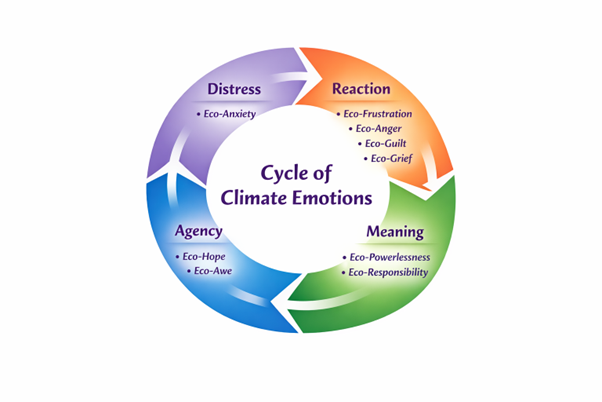
Source: The Capital P Lab
Awareness slays fear
When you look at the journey this way, it doesn't reduce climate change to just fear and then, just solutions. It brings attention to the messy middle - the grief, guilt, anger and helplessness where people actually struggle, reflect, and slowly begin to change.
Identifying this range of emotions is important for a society to maintain robust mental health and resilience. It can change, channelize and align behavioral commitments and action on individual and collective fronts for policy, economic and social benefits.
Mapping Climate Emotions can help take climate action discussions from classrooms to boardrooms and the Parliament and back. And this is how the climate crisis can be addressed - as a journey rather than singular solutions.
If you’ve enjoyed reading this blog post, stay tuned for our upcoming course on Mapping Climate Emotions for Sustainable Climate Solutions.
Enjoyed this article?
Subscribe to get our latest insights delivered to your inbox.
Join the Conversation
Share your thoughts and engage with our community.0 comments
Share Your Thoughts
Your perspective enriches our community
Loading comments...
Continue Reading
More articles you might enjoy
