Huge Potential, Little Footfall - India’s tourism story needs to spotlight the missing link
Exploring a key facet of India's tourism landscape
The Capital P Lab
Contributing Writer
- Tourism Purple tourism Accessibility Tourist destinations Tourism expenditure India Travel and Tourism Development Index

Huge Potential, Little Footfall - India’s tourism story needs to spotlight the missing link
Global tourism picks up pace post COVID-19 induced slum
More tourists, now than ever before are increasingly catching the travel bug. The tourism market has picked up pace and is slowly surpassing pre-pandemic numbers. As per the latest numbers reported by the World Tourism Barometer, a specialized agency of the United Nations, more than 1.1 billion tourists travelled internationally in the first nine months (Jan - Sep) in 2025. This is 50 million more than during the same period in 2024.
Though tourist sentiment is dampened by high costs and geopolitical unrest, in reality, the numbers have shown a positive incline. Brazil, Vietnam, Egypt, Ethiopia and Japan are the top 5 destinations with the highest growth rates in arrivals in the said period.
As per data published by the World Bank, in 2024, global tourism accounted for 10% of the global economy, contributing USD 10.9 trillion to global GDP. The sector supported 357 million jobs worldwide, which is approximately one in every ten jobs, thus highlighting its central role in the labor market.
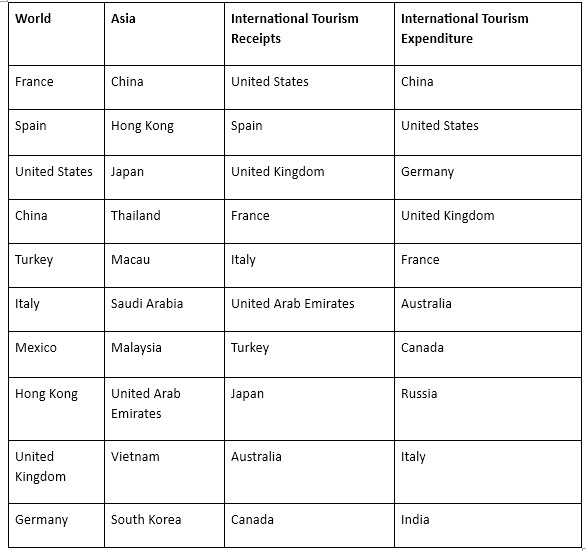
World Leading Tourist Destinations, 2024
Source: United Nations World Tourism Barometer
France, the leading tourist destination globally, attracted 100 million foreign tourists in 2023, followed by Spain (85.2 million) and USA (66.5 million).
Within Asia, China emerged as a top tourist destination in 2024 and 2023, with 64.9 million and 35.5 million international tourists respectively. It was closely followed by Hong Kong, Japan and Thailand.
India - A notable absentee from the Leading Tourist Destination list
The point to note here is that though India is at the tenth position in terms of tourism expenditure, it is neither a top 10 tourist destination globally or in Asia, nor a top 10 destination for tourism receipts. This means that though Indians are travelling internationally, the country is unable to attract foreign tourists with the same gusto.
As per the India Tourist Data Compendium - 2024, in the year 2023, India received only 18.89 million (1.45 %) of the total 1,330 million international tourists. In the year 2023, India received USD 32.2 billion (2.14 %) of the total international tourist receipts and ranked fourteenth. However, the total international tourist expenditure amounted to USD 33.3 ( 2.21%) landing India at the eighth position globally. This international tourist expenditure exceeded the receipt by USD 1.1 billion.
Demographic Profile of Foreign Tourists
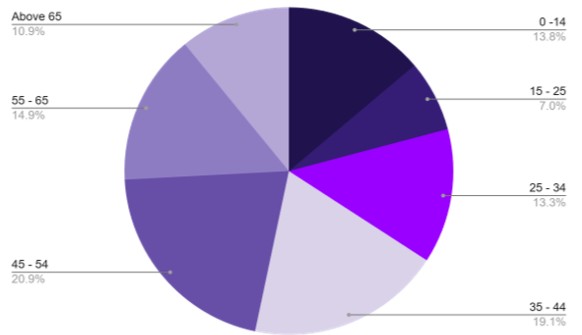
In 2023, approximately 5.9 million foreign tourists visited from 26 G-20 and 6 Gulf Cooperation Council (GCC) countries. Almost 40% of these visitors were in the age-group of 35-54 years.
Chart: Demographic Break-up of Foreign Tourist Arrivals from G-20 and GCC countries in India 2023
Source: India Tourism Data Compendium - 2024
Note: Data is taken for travelers from G-20 and 6 Gulf Cooperation Council Countries (GCC)
Almost 70% of FTA from GCC regions visited India for the purpose of leisure, holiday and recreation. 40% of FTA from G-20 countries is attributed to the Indian diaspora and 39% to leisure, holiday and recreation.
Huge potential going waste
India with a wide diaspora, heritage and natural wonders, does not lack avenues for tourist attraction. It has something for everyone - from an adventurous traveler to a spiritual seeker or a cultural enthusiast. It is also an attractive destination for medical tourism with wellness centers, holistic retreats and the like.
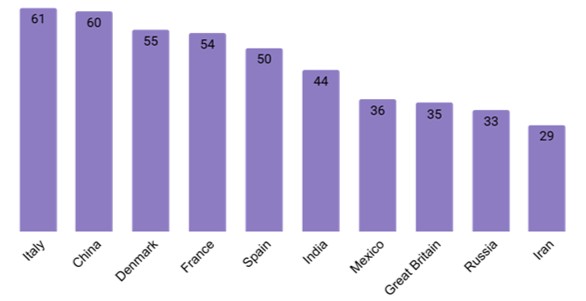
As per UNESCO, India ranks 6th in the world, with 44 world Heritage sites.
Chart: Number of UNESCO Heritage Sites, July 2025
Source: UNESCO
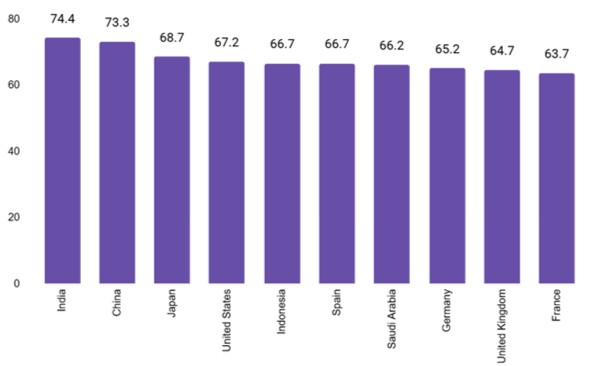
In August 2025, Global Data released a list of countries with highest potential for tourism. The potential index assessed countries on the following 5 parameters:
Tourism Activity
Macroeconomics
Risk
Infrastructure and Development
Attractiveness
Sustainability
India ranked first among the 60 countries that were assessed globally. It was closely followed by China and Japan, both of which are leading tourist destinations in Asia and globally.
Chart: Top 10 Leading Countries in Tourism Potential Index, August 2025
Source: Global Tourism Potential Index - 2025, GlobalData
Reality beyond rose tinted vistas
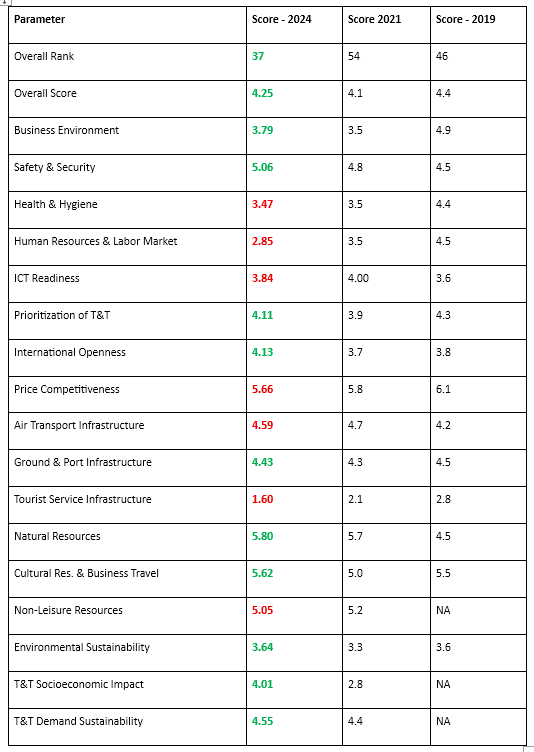
The Tourism Potential Index and India's 37th position in the second edition of World Economic Forum (WEF), Travel and Tourism Development Index (TTDI) (an index that measures factors and policies that enable travel and tourism development in the country) - are statistics that everyone talks about.
But, while a worm's eye view paints a rosy picture of a booming tourism market with tremendous growth and development, a bird’s eye view shows a different story. The percentage share of India in total international tourist arrivals at a global level, has been on a decline since 2020. In 2020, India’s percentage share was 1.56% which declined to 1.4% in 2023. India’s percentage share during the period of 2013-2023 has averaged at 1.26%.
Within the Asia - Pacific region also, the percentage share fell from 28.46% in 2021 to a whopping low of 7.96% (72% decline). India’s percentage share during the period of 2013-2023 has also averaged 9.56%.
The 37th position may look good, however, when compared to WEF’s Travel and Tourism Rankings, 2021 and 2019, the country’s overall score has not changed much.
Table: Travel and Tourism Development Index (TTDI) Score Comparisons, 2019-2024
Source: World Economic Forum
The missing link
Thus, India’s tourism potential and its share in the global tourism pie and rankings, do not support and complement each other. Home to numerous UNESCO heritage sites, long coastlines with serene beaches, mountain ranges, culture and cuisine and spiritual sites, something to suit everyone’s palette, should have made India a leading tourist destination not just in Asia but also globally.
A cursory study points to various reasons like pollution, safety and lack of infrastructure. However, inadequacy in terms of built-in infrastructure, Information and Communication Technology (ICT) and transportation may be a bigger contributor.
So, is accessibility or better put, a lack of it then, a major culprit? Is India’s tourism market overlooking a huge consumer base of the elderly, pregnant women, families with little children and people with disabilities? Are their travel plans falling through the cracks just because last mile connectivity in major tourist hotspots in India is not inclusive, mindful and participative? Something to think about!
Do wait for the next blog to find out as we explore the link between accessibility and the tourism sector in more than one interesting way. This is the first blog in a series covering ESG Interdependencies.
Enjoyed this article?
Subscribe to get our latest insights delivered to your inbox.
Join the Conversation
Share your thoughts and engage with our community.0 comments
Share Your Thoughts
Your perspective enriches our community
Loading comments...
