Sensory Inclusion: The Dialogue Opens Up
Sensory Inclusion, the key to unlock equitable participation
The Capital P Lab
Contributing Writer
- Universal Design Sensory Inclusion Sensory Needs Emerging Conversations Coldplay Concert Bengaluru Airport Sugamya Bharat Abhiyan RPwD Act ADHD ASD
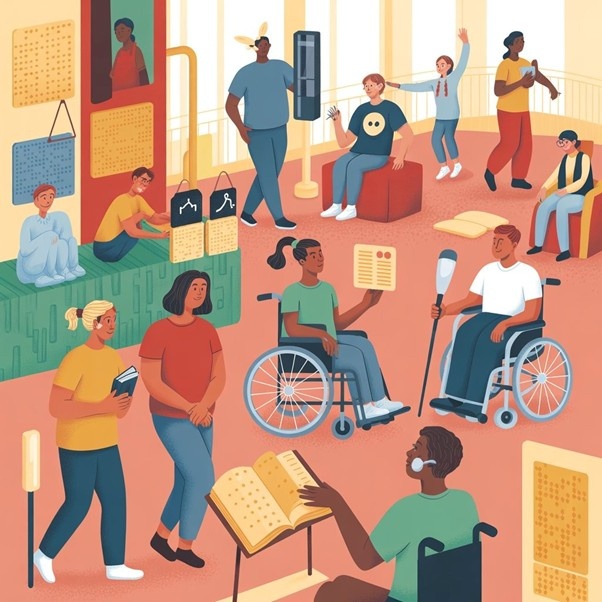
Sensory Inclusion: The Dialogue Opens Up
Sensory Sensitivities impact a larger population
All living beings feel and perceive their environment and surroundings through their sensory organs. Sensory processing is the process by which our brain receives and interprets information through 8 senses:
Sight
Sound
Touch
Hear
Smell
Movement
Balance
Interoception (internal sensations like hunger, fatigue etc)
Most of us are well-equipped to receive and interpret sensory information in a calm and controlled manner. These sensory inputs help us enjoy the company of friends, laser light shows, enthralling and over-packed concerts, chug a chug and whistle blows of engines and conch shells and loud chants.However, these pleasant experiences can be overbearing and overwhelming for some of our friends and family. Large crowds can be a source of anxiety, loud noises can irritate and bright lights can be blinding. We all know at least one person who avoids large gatherings or a child who closes his ears at loud noises. A cranky child on the supermarket floor or an irritated elderly on the temple footsteps are common enough sights.
In most of these occurrences, the unexpected behaviour is caused by a sensory overload. The brain is unable to process the high volume of sensory stimuli that the individual is exposed to and this leads to anxiousness and discomfort.
Most commonly, sensory sensitivities and overloads are seen to impact people with neurodivergent conditions like:
Autism Spectrum Disorder (ASD)
ADHD (Attention Deficit Hyperactivity Disorder)
Dyslexia, Dyscalculia, Dysgraphia
Tourette Syndrome
Sensory Processing Disorder
Other neurodevelopmental or cognitive differences like dyspraxia or intellectual variations
In reality, in addition, sensory overloads also cause discomfort to people with PTSD (post traumatic stress disorder), people with hearing and vision loss and elderly people (above 60 years of age) who experience age related sensory losses.
A study by INCLEN Trust International, estimates that 1 in 8 children between the age-group of 2 - 9 years are neurodivergent in India. As per the 2024 Census, children aged 0-9 make up around 17.47% of India's population, totalling to approximately 251 million. Neurodivergent children stand at 31.41 million of this number. Globally, it is estimated that 15-20% of the world population is neurodivergent. Although accurate data on neurodivergent individuals is not available, we can estimate that there are more than 200 million diagnosed and undiagnosed neurodivergent individuals.
In addition, as per a 2022 report by National Institutes of Health (NIH), in India, around 59% and 21% of older adults reported vision and hearing difficulty, respectively. The total elderly population was approximated to be about 149 million in 2022. Approximately 119 million suffer from vision and hearing loss.
Chart 1: Total percentage of elderly population exposed to sensory overload due to vision and hearing loss
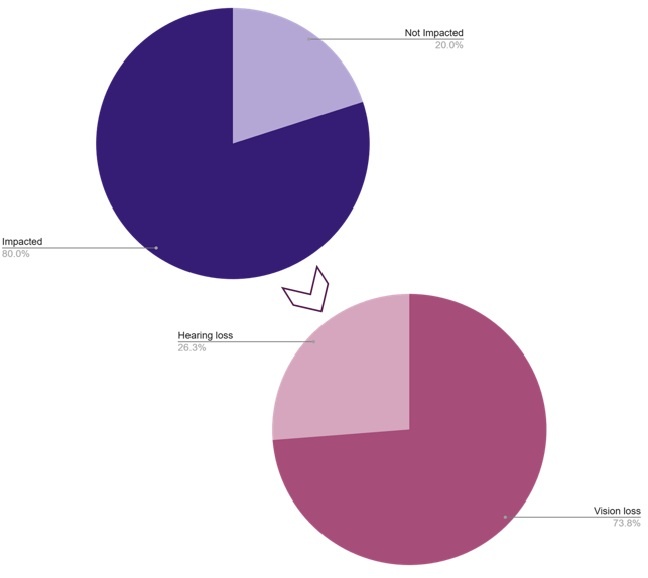
Source: National Institutes of Health, 2022
Though relying on estimates and impacted by research gaps, these statistics still point to a large population size (approximately 23%, 330 million) impacted by sensory overload on a temporary and permanent basis.
What is Sensory Inclusion?
Sensory inclusion is the practice of designing environments and experiences in a way that people with different sensory needs can participate comfortably.
Sensory inputs like light, sound, touch, movement and smell are processed differently and provisions for inclusion for the same should be inherent.
How to implement sensory inclusion
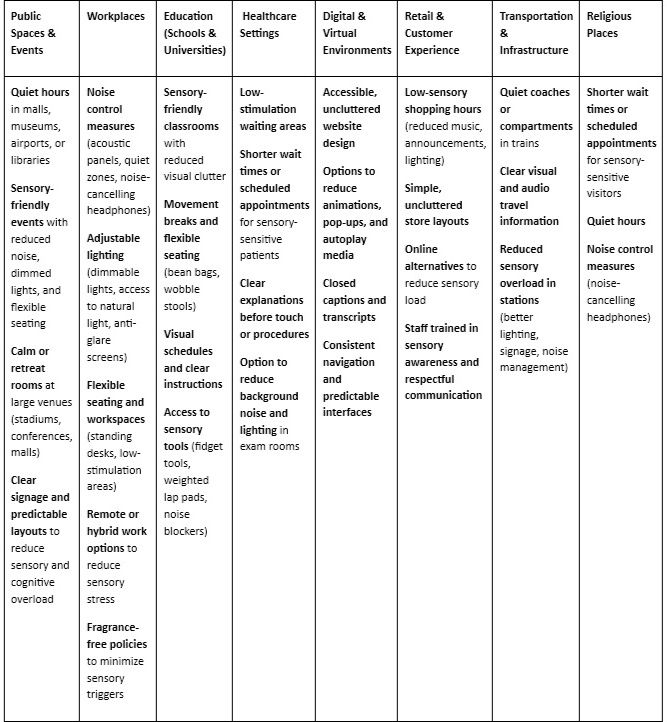
Sensory Inclusion in India: An Emerging Conversation
Sensory Inclusion in India at the moment is at a nascent stage. Awareness is largely driven by civil society initiatives, parent advocacy and a few pilot initiatives like a sensory room in Bangalore airport, sensory parks in Chennai or sensory inclusion in Coldplay concerts. These have opened up the dialogue about sensory inclusion and helped introduce the concept into public discourse.
Also, a growing awareness about neurodivergent conditions are giving discussions regarding sensory inclusion a platform. Organisations like Sensory All, Incluzza and Access for ALL are working towards designing and implementing sensory inclusive spaces and products to reduce sensory overload. They are demonstrating that small design changes can significantly improve and include in the experience, a wider range of users.
However, these remain few and far, isolated interventions rather than systemic design practices, and are often framed as special accommodations rather than everyday design considerations.Government policies and programs like the RPwD Act and the Sugamya Bharat Abhiyan primarily focus on physical disability and digital access but are yet to translate sensory needs into concrete design frameworks for public or private infrastructure.
That said, instead of looking at the above as a need to create an entirely new programme, Universal Design can offer meaningful integration of sensory needs as India updates urban design standards.
Sensory Inclusion Within Universal Design
Like accessibility features, sensory inclusion has to be implemented under the ambit of Universal Design
Sensory inclusion fits naturally within the ambit of Universal Design. It should be embedded and integrated into design rather than be treated as a retrofit solution. Just as ramps and lifts work best when integrated into design, so are sensory considerations most effective when they are embedded into core design. Sensory Inclusion aligns closely with principles of UD like equitable use, perceptible information, low physical effort, tolerance for error and simple, intuitive use. By managing sound, light, spatial complexity, and information overload, sensory-aware environments reduce cognitive and emotional strain for a wide range of users.
Why This Matters for India
As India urbanizes rapidly and its public spaces grow denser, sensory environments are becoming more intense rather than more inclusive. Addressing sensory inclusion early—through universal design—offers a chance to create cities, schools, transport systems, and cultural spaces that are not only accessible, but genuinely usable and humane. Moving from isolated pilots to embedded practice will be key to ensuring that inclusion keeps pace with growth.
Enjoyed this article?
Subscribe to get our latest insights delivered to your inbox.
Join the Conversation
Share your thoughts and engage with our community.0 comments
Share Your Thoughts
Your perspective enriches our community
Loading comments...
Continue Reading
More articles you might enjoy

Bridging the Gap: Accessibility at the Heart of Urban Climate Resilience
How disability inclusion is critical to translating climate policy into on-ground resilience

Building a Purple Workforce
Empowering Ability through Employment

Why Universal Design Matters for an Inclusive Society?
Reactive accessibility is burdensome, Universal Design from get go