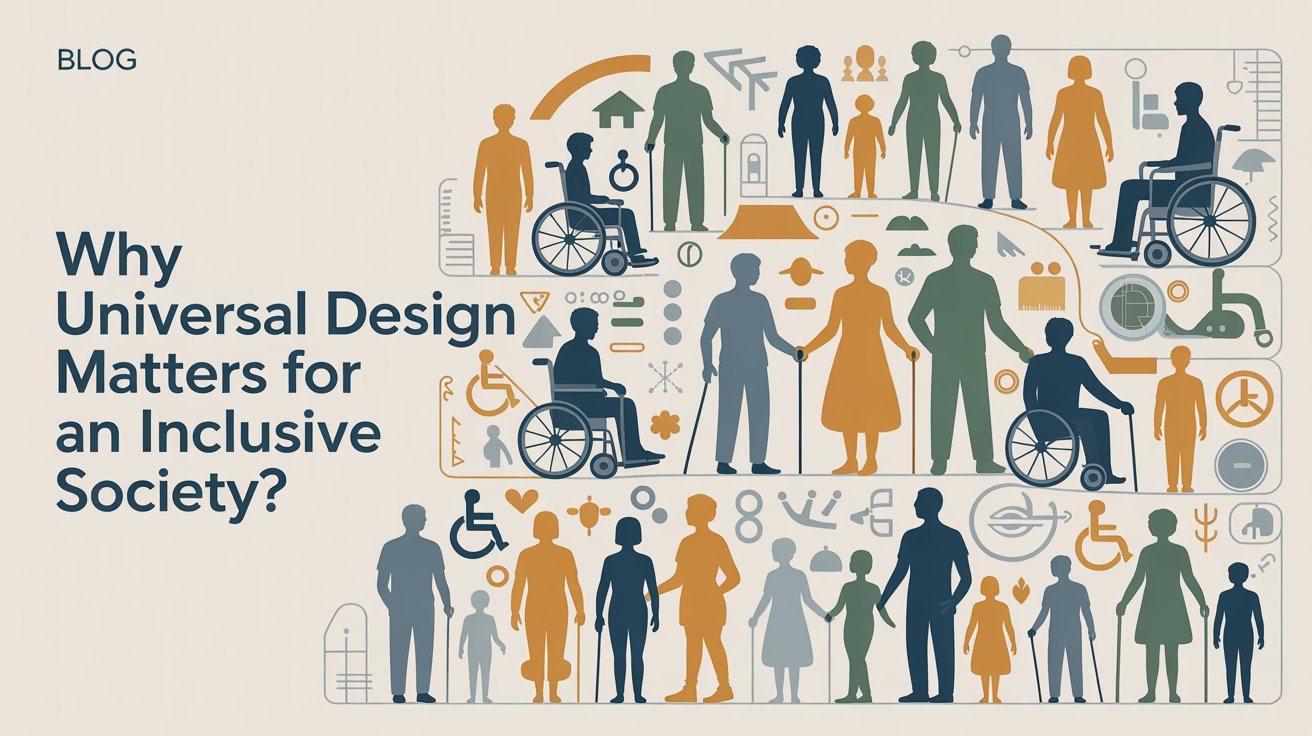
Why Universal Design Matters for an Inclusive Society?
Reactive accessibility is burdensome, Universal Design from get go
The Capital P Lab
Contributing Writer
- Universal Design
- Inclusive Society
- reduce retrofitting
- reactive accessibility
- barrier free design
- assisstive technology
Why Universal Design Matters for an Inclusive Society?
Universal Design Embraces Human Diversity
Universal Design starts with a simple but powerful idea: people are diverse, and good design should anticipate that diversity, rather than react to exclusion later. Human abilities vary across age, body, sensory perception, cognition, and circumstance—and these variations change across a lifetime. Universal Design therefore asks designers, planners, and policymakers to move away from designing for an imagined ‘average user’ and instead create environments, products, and services for as many people as possible.
The term Universal Design was popularized by architect Ronald Mace, who argued that accessibility should not be an afterthought or an add-on. He purported a design philosophy that makes spaces and systems usable by the widest possible range of people, without the need for adaptation or specialized solutions. Instead of designing first and fixing later, universal design integrates inclusion at the earliest stages—whether in buildings, transport, digital platforms, or public services and spaces.
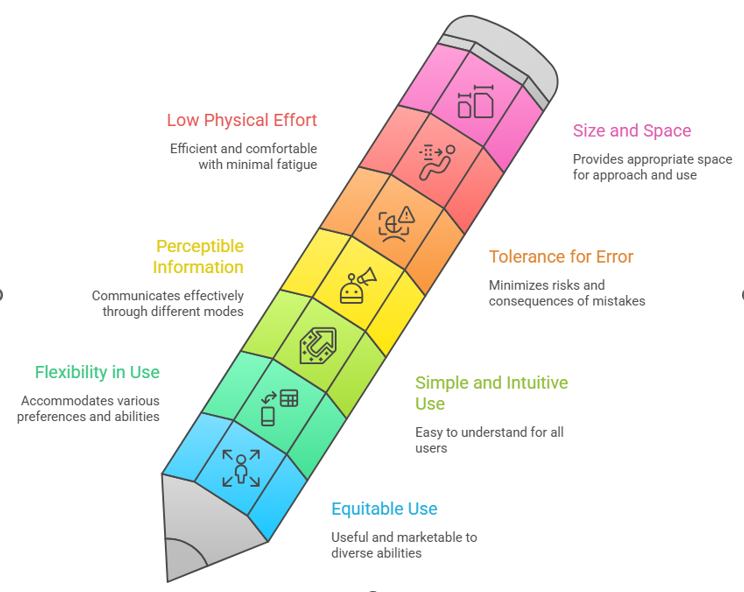
The 7 Principles
The principles of Universal Design (UD) were established by a working group of architects, product designers, engineers and environmental design researchers headed by architect Ronald Mace in 1977 at North Carolina State University, The Center for Universal Design.
They laid out 7 criteria that enable products and environments to be designed and executed in more equitable and inclusive ways with little adaptation or customization.
Figure 1: The Seven Principles of Universal Design
Common examples include:
Power doors with sensors at entrance
Moving sidewalks and escalators in public areas
Ramps
Tactile, visual and audible cues
Voice communication and signage at airports, railway stations and public places
Voice controlled machines
Moving Beyond Reactive Accessibility
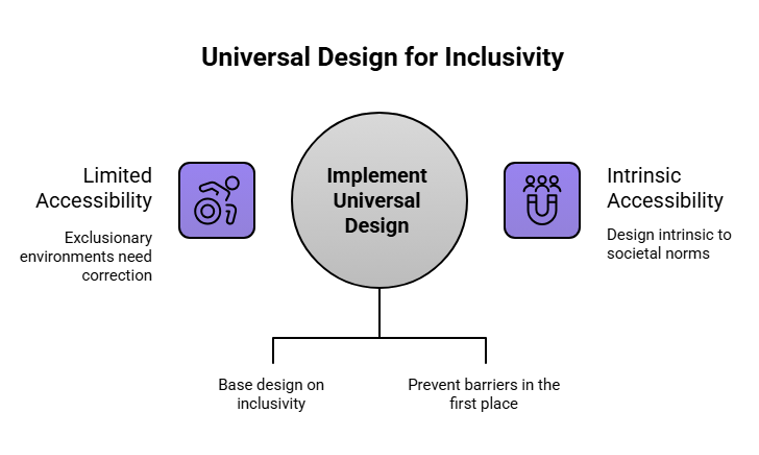
Where implementation of Universal Design fails, lack of accessibility cripples and a vicious cycle of build- adapt-rebuild comes into play.
Accessibility is limited to providing access for persons with disabilities, typically through specific features such as ramps, lifts, or reserved seating. While essential, it also behooves one to understand that it in fact, largely comes into play when environments are already exclusionary and need to be corrected. In this sense, accessibility is often a response to poor design.
Universal Design, by contrast, is based on the premise of non-discrimination and inclusivity. It reduces and to a certain extent eliminates the need for retrofitting and thereby preventing barriers in the first place.
When done well, the principles enumerated earlier allow accessibility to move from a segregated, separate category of design to one that is intrinsic to societal norms, responsibilities and common public discourse.
Figure 2: Accessibility in an intrinsic and proactive facet of Universal Design
Ambit of Universal Design
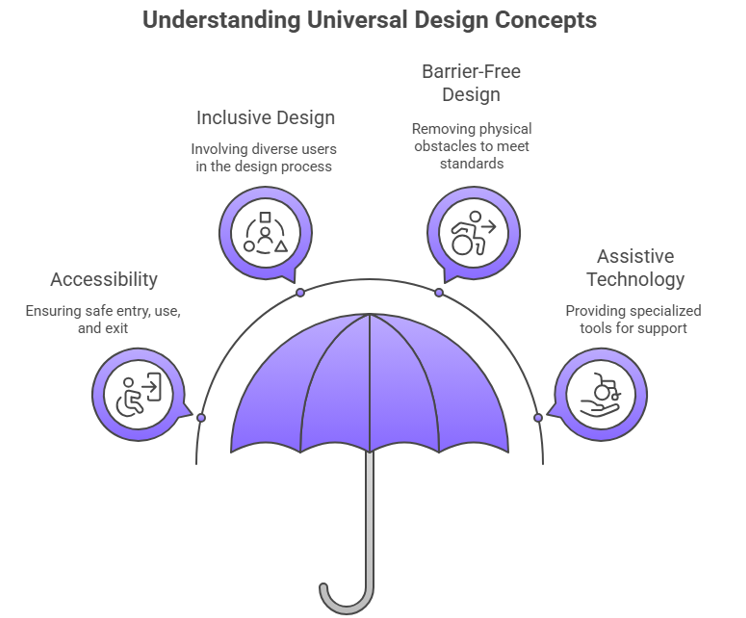
In the absence of clarity on Universal Design, several terms are often used interchangeably with concepts encompassing inclusion.
Accessibility focuses on whether a person can enter, use, and exit a space safely.
Inclusive design emphasizes involving diverse users in the initial design process itself.
Barrier-free design typically refers to removing physical obstacles, often to meet minimum standards.
Assistive technology supports individuals through specialized tools such as screen readers or mobility aids.
Universal Design sits above all these concepts as an overarching approach that benefits everyone.
Figure 3: Universal Design as an umbrella concept
A Philosophy that propels Social Inclusion
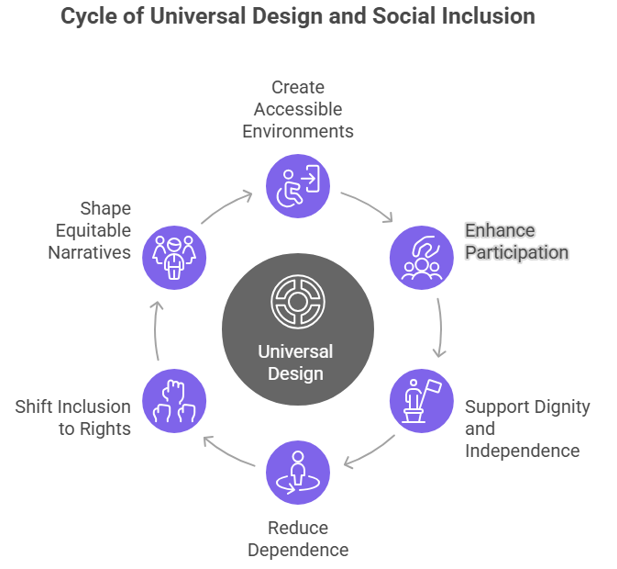
Universal Design is not limited to or by design efficiency but is deeply connected to social inclusion. When environments are easy to navigate and understand, people can participate more fully in education, work, culture, and community life.
It supports dignity, independence, and choice, particularly for older adults, people with disabilities, caregivers, and those with invisible or temporary impairments. By reducing dependence on assistance, Universal Design helps shift inclusion from charity to rights and autonomy, from a limited space in public discourse to shaping strong narratives around an equitable society in the true sense of the term.
Figure 4: Universal Design accelerates Social Inclusion
From Obligation to Responsibility
Universal Design urges us to move beyond fixing exclusion and instead, prevent it through anticipatory, inclusive thinking. By recognising human diversity as the norm, it shifts accessibility from a reactive obligation to a shared societal responsibility.
When inclusion is embedded from the outset, environments become not only more usable, but more just—strengthening participation, dignity, and autonomy for all.
In the next piece, this conversation moves from principle to practice—examining global examples of Universal Design in action and exploring how similar ideas are reflected, enabled, or limited within India’s policy landscape.
Enjoyed this article?
Subscribe to get our latest insights delivered to your inbox.
Join the Conversation
Share your thoughts and engage with our community.0 comments
Share Your Thoughts
Your perspective enriches our community
Loading comments...
Continue Reading
More articles you might enjoy

Sensory Inclusion: The Dialogue Opens Up
Sensory Inclusion, the key to unlock equitable participation

Bridging the Gap: Accessibility at the Heart of Urban Climate Resilience
How disability inclusion is critical to translating climate policy into on-ground resilience

Building a Purple Workforce
Empowering Ability through Employment