Bridging the Gap: Accessibility at the Heart of Urban Climate Resilience
How disability inclusion is critical to translating climate policy into on-ground resilience
The Capital P Lab
Contributing Writer
- Urban Climate Resilience
- Accessibility
- Disaster Preparedness
- Disaster Management
- Sendai Framework
Blog 8_Cover Pic
India’s climate risk profile is intensifying rapidly. In 2024 alone, the country recorded extreme weather events on 322 of 365 days, resulting in more than 3400 deaths. These hazards span very different geographies: recurring floods in Assam, cyclones along the Odisha coast, glacial lake outburst floods and landslides in Uttarakhand, and increasing urban heat and flooding in cities across Maharashtra and Karnataka.
Across these disasters, persons with disabilities are among the least able to access early warning systems, evacuate safely, reach emergency shelters, or claim post-disaster relief.
India officially records 28.6 million persons with disabilities, based on the 2011 Census. However, this figure reflects a definition narrower than that established under the Rights of Persons with Disabilities Act, 2016. Globally, the World Health Organization estimates disability prevalence at around 16 percent of any population. India’s official rate of 2.21 percent therefore almost certainly represents a substantial undercount.
This gap matters because disaster governance systems plan around the data they have. When persons with disabilities are not counted, they are rarely planned for.
India’s Policy Framework Is Strong — So Why Does the Gap Persist?
At first glance, India’s policy architecture for disability-inclusive disaster governance appears strong.
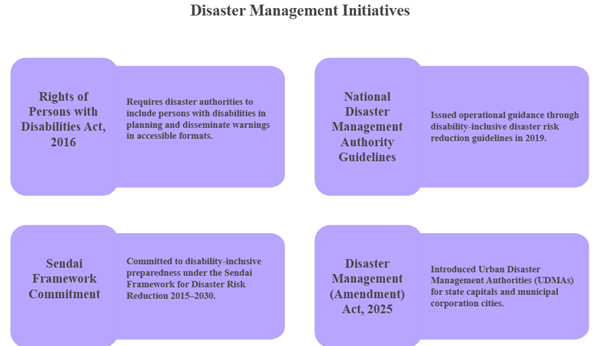
Yet despite the above commitments, disability inclusion remains largely absent in disaster practice at the state and district levels.
The central question is therefore not whether India has the necessary policy framework. It is why the translation from policy commitment to operational practice fails so consistently.
Four Structural Gaps in Implementation
Evidence from six states — Kerala, Karnataka, Odisha, Maharashtra, Assam, and Uttarakhand — suggests that disability inclusion in disaster governance is constrained by four structural gaps.
1. The First-Responder Training Gap
India’s main community response programme is the Aapda Mitra Scheme, which aims to train 100,000 volunteers across 350 districts in the country. The programme includes instruction in flood rescue, first aid, and search-and-rescue operations. However, a review of its training curriculum shows that disability-specific evacuation techniques are absent.
India’s primary disaster volunteer programme trains ‘able-bodied community volunteers’
Disability Justice Advocate Diksha Dinde concurs that it is in training and simulation exercises that gaps exist and therefore become impossible to ignore. There is an urgent need to move from treating people with disabilities as a vulnerable group to be “rescued” rather than as active participants in preparedness.
Kerala offers a notable exception. The Kerala State Disaster Management Authority, in partnership with civil society organizations, developed the SAHIT training manual in 2023. This supplementary module provides operational guidance for assisting persons with disabilities across different disaster scenarios. Kerala’s approach is instructive because it did not replace the national programme. Instead, it used the Aapda Mitra infrastructure and layered disability training on top of it, demonstrating how national schemes can be adapted to become inclusive. An additional layer is that of gender with Uttar Pradesh introducing a parallel Aapda Sakhi Initiative to recruit women volunteers, but these programmes still lack disability-specific training.
2. The Disability Data Deficit
The second structural constraint concerns data architecture.
India’s official disability prevalence rate of 2.21 percent contrasts sharply with global estimates of around 16 percent. This gap reflects social stigma, weak registration incentives, and the absence of systematic data collection within disaster governance systems.
As a result, municipal planners often rely on proxies such as age or poverty levels to identify vulnerable populations. These indicators do not capture disability-specific needs, instead in fact flatten diversity.
Consultations with the humanitarian NGOs working in the space illustrate the operational consequences. Responders reported that they typically do not have disability data before reaching disaster sites, making disability-specific planning impossible during the initial response phase.
“Disability data sits with specialists. Disaster responders are generalists. The two systems rarely connect before disasters.”
The deeper issue is institutional fragmentation: disability-focused organizations often hold population data, while disaster responders operate within separate networks. The two systems rarely exchange information before disasters occur.
The new disaster databases introduced under the 2025 amendment could address this problem. However, the legislation does not yet require disability-disaggregated data, leaving a critical gap in the data architecture of disaster governance.
3. Infrastructure and Early Warning Accessibility
The third structural gap concerns whether disaster infrastructure is designed to be usable by persons with disabilities.
Early warning systems typically rely on sirens, SMS alerts, or broadcast announcements, which may exclude people with hearing or visual impairments. Even advanced systems like. Odisha’s coastal siren network that covers more than 1,200 villages, does not incorporate adaptations for people with hearing disabilities.
Similarly, city-level heat action plans in states such as Karnataka include warning systems for extreme heat but do not address how those warnings reach persons with sensory disabilities.
Elsewhere in India, the Common Alerting System exists but in terms of inclusivity and last mile connectivity for people with disabilities, it leaves much to be desired. A 2022 accessibility audit of Emergency shelters found that only about 30 percent of post-flood shelters in Kerala - widely considered a leader in disability inclusion - were wheelchair accessible. During her visit to a quarantine center during the Covid-19 pandemic, Diksha Dinde recalls that there were no wheelchairs or ramps, highlighting the absence of basic accessibility measures in emergency settings. In contrast, when she was in the UK, she came across something called PEEP - a Personal Emergency Evacuation Plan - where her university created a personalized evacuation plan for every disabled student living on campus to ensure their safety in emergencies.
4. Institutional Architecture
The final structural gap concerns who is responsible for ensuring disability inclusion within disaster governance systems.
Research on disaster policy implementation in India shows a consistent pattern: disability provisions decline as policies move from national frameworks to state and district implementation. The dilution is most severe at the district level, where operational decisions are made.
“Disability provisions weaken as disaster policy moves from national commitments to local implementation.”
Only a small proportion of disaster management cells have staff trained in disability inclusion, and compliance with disability provisions is rarely monitored or enforced.
State experiences illustrate this pattern. Karnataka’s disaster authority produces technically detailed planning documents, yet disability rarely appears as a planning variable.
Odisha offers a partial institutional innovation. The Odisha State Disaster Management Authority has established a Gender and Inclusion Cell, the first of its kind within an Indian disaster authority.
The Urban Disaster Management Authorities created under the 2025 amendment represent a rare opportunity for institutional redesign. Because these bodies are new, their planning frameworks and governance structures are still being defined. Yet the legislation establishing them makes no explicit reference to disability inclusion, leaving the opportunity unrealized.
From Policy to Practice
India already has the building blocks for disability-inclusive disaster governance. The gap lies in translating these commitments into enforceable, on-ground practice.
Three shifts are critical: integrating disability-disaggregated data into disaster systems, embedding inclusive training within programmes like Aapda Mitra, and ensuring accessible infrastructure and early warning mechanisms—especially within the new Urban Disaster Management Authorities.
“The question of whether people with disabilities are included in India’s climate resilience systems is being decided now.”
With institutional frameworks being shaped- Urban Disaster Management Authorities created under the 2025 amendment are currently defining their operational frameworks and global commitments under Sendai Framework for Disaster Risk Reduction approaching its 2030 deadline, the moment is immediate. The strength of India’s climate resilience will ultimately be measured by how inclusive it is—and the time to act is now.
Enjoyed this article?
Subscribe to get our latest insights delivered to your inbox.
Join the Conversation
Share your thoughts and engage with our community.0 comments
Share Your Thoughts
Your perspective enriches our community
Loading comments...
Continue Reading
More articles you might enjoy

Sensory Inclusion: The Dialogue Opens Up
Sensory Inclusion, the key to unlock equitable participation

Building a Purple Workforce
Empowering Ability through Employment

Why Universal Design Matters for an Inclusive Society?
Reactive accessibility is burdensome, Universal Design from get go