Building a Purple Workforce
Empowering Ability through Employment
The Capital P Lab - IDEA
Contributing Writer
- #DivyangjanKaushalYojana #AVGC #Hospitality #FoodProcessing #IT/ITES #Market Potential
Untapped Talent
Unemployment among persons with disabilities (PwDs), often referred to as Divyangjan in India, remains a significant social and economic challenge despite policy efforts aimed at promoting inclusion. According to the Rights of Persons with Disabilities Act, 2016, persons with disabilities are entitled to equal opportunities in education, skill development, and employment. However, many PwDs continue to face barriers such as limited access to education and vocational training, inaccessible workplaces, lack of assistive technologies, and social stigma. These challenges result in a large proportion of PwDs remaining outside the formal labor force, particularly in rural and marginalized communities.
India has an estimated 26.8 million persons with disabilities (Census 2011), with the Unique Disability ID (UDID) database now holding over 1.25 crore registrations. Yet the country faces a multi-layered crisis of disability exclusion from the workforce.
The Government of India has introduced several initiatives to promote employment and self-reliance among persons with disabilities (PwDs). Programs such as the Pradhan Mantri Kaushal Vikas Yojana, and Prime Minister's Employment Generation Programme provide skill training, financial assistance, and entrepreneurship support. These initiatives aim to improve employability, enable self-employment, and promote economic independence for PwDs across various sectors.
Divyangjan Kaushal Yojana
Divyangjan Kaushal Yojana was launched by the Department of Empowerment of Persons with Disabilities under the Ministry of Social Justice and Empowerment to promote skill development and enhance employment opportunities for persons with disabilities (Divyangjan) in India. The scheme was introduced in response to significant barriers faced by persons with disabilities in accessing education, vocational training, and formal employment. It aligns with the provisions of the Rights of Persons with Disabilities Act, 2016, which emphasizes equal opportunity, economic participation, and inclusive development and complements broader national skill development initiatives such as the Skill India Mission, the Divyangjan Swavlamban Yojana and the Vishesh Microfinance Yojana.
Target Sectors and Market Growth
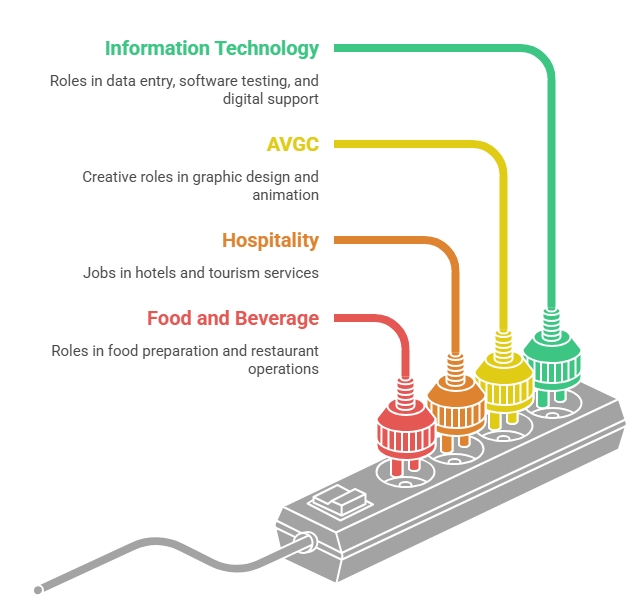
The sectors above were selected under the Divyangjan Kaushal Yojana because they often involve process-driven, task-based work that can be adapted to different disability groups, allowing for better job matching and improved employment outcomes. The focus is on providing industry-relevant, customized training aligned with the functional abilities of different Divyangjan categories to ensure dignified livelihood opportunities.
They have a high growth and employment generation potential. If 5% of these jobs are earmarked for the PwDs, their representation will substantially increase in the urban workforce.
Summary inclusion potential by sector is given below, where the rating
Table: Disability Sector Compatibility Matrix
Sector | Inclusion Potential | Rationale |
|---|---|---|
IT / ITES | Very High | Sector is highly inclusive due to its digital and desk-based nature, allowing work to be performed remotely or in accessible office settings. Tasks such as data entry, coding, testing, and customer support can be adapted using assistive technologies like screen readers, speech-to-text tools, and accessible software. Flexible work hours, minimal physical mobility requirements, and growing acceptance of remote work further enhance participation of PwDs across disability types. |
AVGC | High | This sector relies on creative and digital skills, making it suitable for PwDs, especially those with locomotor or hearing impairments. Work environments are often flexible, project-based, and studio-oriented, allowing customization of roles. Tools and software used in animation and design can be adapted, and many roles emphasize individual creativity over physical ability, enabling inclusive participation. |
Food Processing | Moderate–High | The sector offers a diverse range of roles across production, packaging, quality control, and logistics. Many tasks are process-driven and repetitive, making them suitable for PwDs with appropriate training. With reasonable workplace modifications (like ergonomic setups or assistive devices), individuals with locomotor, hearing, or mild intellectual disabilities can be effectively employed. However, some roles may require physical stamina or adherence to strict safety norms, slightly limiting full inclusivity. |
Hospitality | Moderate | While hospitality has high employment potential, inclusion is moderate due to the customer-facing nature of many roles, which require communication skills, mobility, and social interaction. However, there are significant opportunities in back-end roles such as housekeeping management, kitchen assistance, inventory handling, reservations, and administrative functions. Inclusive hiring can be improved with sensitization, accessible infrastructure, and role customization. |
Source: The Capital P Lab analysis
Table: Market Growth and Employment Projections for the sector
Sector | Growth Projection | Employment Demand / Job Creation | Employment Opportunity for People with Disabilities* | Key Drivers of Growth |
|---|---|---|---|---|
Information Technology (IT) | Industry projected to reach ~$350 billion revenue by FY2026, growing about 6.1% annually | Workforce expected to increase to ~5.95 million employees, with ~135,000 new jobs added in FY2026 | Approximately 297,500 jobs available in FY 2026 | AI adoption, digital transformation, global IT services demand |
Animation, Visual Effects, Gaming & Comics (AVGC) | The sector is expected to reach USD 6.8 billion by 2026 growing at nearly 29% annually | Long-term projections suggest up to ~ 2 million high-tech jobs in emerging AVGC ecosystems by 2030 | Approximately 100,000 jobs by FY 2030 | Growth of gaming, OTT platforms, digital content production, metaverse technologies |
Hospitality & Tourism | The sector is projected to reach USD 60 billion by 2028 | The sector needs to add additional 3 million jobs by 2028 The sector is projected to support 64 million jobs by 2035 | Approximately 150,000 additional jobs by FY 2028 The sector shall support 320,000 jobs by 2035 | Rising domestic tourism, MICE events, smart tourism technologies |
Food & Beverage (Considered as Food Processing Industry) | The sector is expected to reach USD 1,274 billion in 2027 from USD 866 billion in 2022 | In FY25, 1.93 million people in the registered sector and 5.1 million workers in the unregistered sector | Though employment projections are not available, looking at the growth potential, the sector can be an employment driver for PwDs | Infrastructure Support, FDI and various supportive schemes |
*For analysis we are assuming 5% of the jobs to be allocated for Persons with Disabilities (PwD)
Source: The Capital P Lab analysis
Conclusion
Addressing unemployment among persons with disabilities (PwDs) in India requires a shift from fragmented interventions to a cohesive, ecosystem-driven approach. While policies such as the Rights of Persons with Disabilities Act, 2016 and schemes like Divyangjan Kaushal Yojana have laid a strong foundation, existing gaps in awareness, accessibility, skill alignment, and inclusive hiring continue to limit their impact. The analysis above highlights that high-growth sectors such as IT/ITES, AVGC, Hospitality, and Food Processing hold significant potential to absorb PwDs into the workforce, particularly when supported by targeted skilling, assistive technologies, and employer sensitization.
If even a modest proportion—such as 5%—of projected job creation in these sectors is made inclusive, it could substantially improve workforce participation among PwDs, especially in urban and semi-urban areas. However, to translate this potential into reality, there is a need for stronger convergence between government schemes, industry demand, and grassroots implementation. This includes improving last-mile awareness, expanding access to training in rural areas, fostering public-private partnerships, and ensuring that jobs are not only accessible but also aligned with the skills and aspirations of PwDs.
Ultimately, building an inclusive workforce is not just a social imperative but an economic opportunity. By unlocking the productive potential of PwDs, India can move closer to achieving equitable growth, social justice, and true economic inclusion in its development trajectory.
For a more detailed analysis report, please drop in a message at contact@capitalp.org
Enjoyed this article?
Subscribe to get our latest insights delivered to your inbox.
Join the Conversation
Share your thoughts and engage with our community.0 comments
Share Your Thoughts
Your perspective enriches our community
Loading comments...
Continue Reading
More articles you might enjoy

Sensory Inclusion: The Dialogue Opens Up
Sensory Inclusion, the key to unlock equitable participation

Bridging the Gap: Accessibility at the Heart of Urban Climate Resilience
How disability inclusion is critical to translating climate policy into on-ground resilience

Why Universal Design Matters for an Inclusive Society?
Reactive accessibility is burdensome, Universal Design from get go